SOLIDWORKS Cloud
Introduction
Open iT supports 3DEXPERIENCE SOLIDWORKS usage reporting. The following sections will guide you on the required configuration for license manager utility polling and poll parsing.
Requirements
- An Open iT Core Client connected to an Open iT Core Server or a coexistent Open iT Core setup
- Activated LicenseAnalyzer collection
- Non-SSO SOLIDWORKS cloud account with administrator access to the 3DEXPERIENCE platform, which is https://www.solidworks.com/product/solidworks-xdesign by default
- 3DEXPERIENCE platfrom ID
- Configured Microsoft Entra Credentials
- Configured application sign-in to vendor license mapping
For a comprehensive Entitled User Sign-in Signals portlet report, make sure that the Microsoft Entra HR Roster collection is configured properly, as it plays a crucial role in providing essential sign-in data.
Getting the Platform ID in 3DEXPERIENCE
The Platform ID is a unique identifier for your 3DEXPERIENCE platform (tenant). It is required when configuring connections, authenticating, or integrating with the platform.
-
Open your 3DEXPERIENCE platform in a web browser.
-
Log in using your administrator credentials.
-
Check the URL in the address bar.
The Platform ID is typically part of the URL.
Examplehttps://mycompany-platform.3dexperience.3ds.comIn this example:
Platform ID = mycompany-platform
noteThe Platform ID is typically part of the platform URL but may exclude regional or infrastructure suffixes (such as
-eu1or-us2). It is unique to each organization and may follow different naming conventions or patterns. If you are unsure of the Platform ID, verify it with your administrator or IT team.
Configuring License Manager Utility Polling
Open iT polls the license servers at regular intervals to get the current status of its license use and availability.
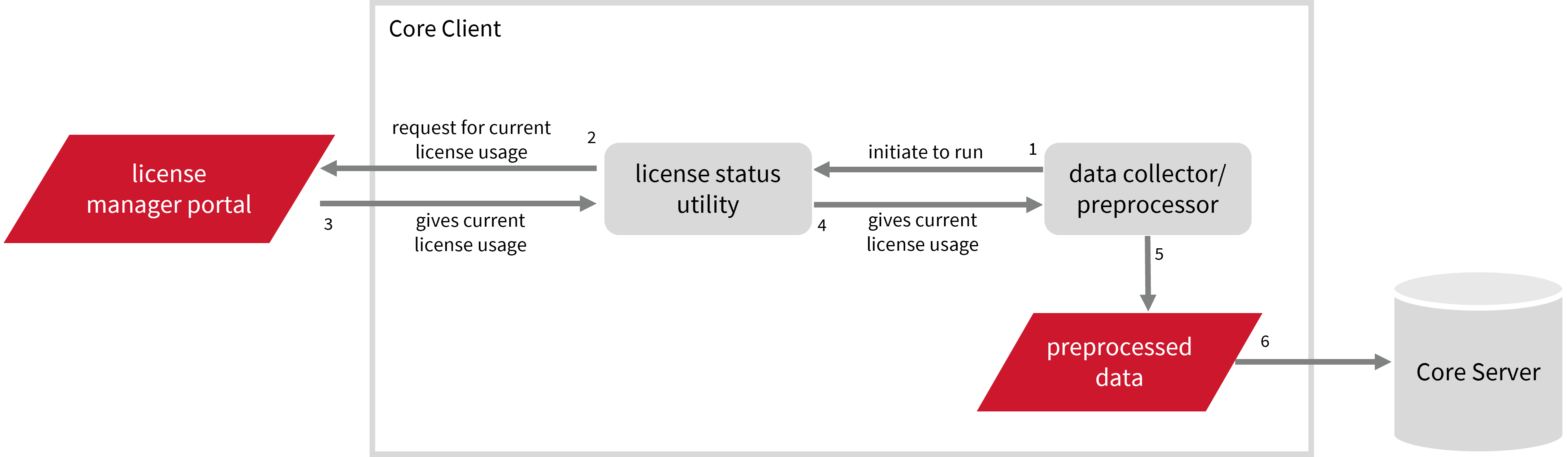
For this collection, the data source is through an API. The data collector/preprocessor initiates the license status utility every hour using a 5-minute sample interval, triggering the data collection process. The license status utility requests the current license usage data from the license manager portal. After the license manager portal provides the requested data, the license status utility passes this information to the data collector/preprocessor. The data collector/preprocessor processes the data, preparing it for transmission. Finally, the preprocessed data is sent to the Core Server every night, according to the client's timezone, for further storage, completing the license usage data collection and processing.
This will produce the following aggregated data types used for historical reporting:
- (49) Host User License Use
- (93) OLAP Raw Hourly
- (94) OLAP User Concurrency
- (95) Usergroup License Use v3.0
- (102) OLAP Total Use
Apply the configurations shown in the Open iT Core Client.
Setting up SOLIDWORKS Cloud Data Collection
These are the required steps to set up data collection from the 3DEXPERIENCE portal.
- Windows
- Unix
-
Open a command prompt with Administrator level privileges.
-
Go to the bin directory, which is by default in
C:\Program Files\OpeniT\Core\bin, run the command:Command Syntaxcd <bin_dir>Examplecd C:\Program Files\OpeniT\Core\bin -
Set the username, password, and platform ID, run the command:
Command Syntaxgenlicutil2 solidworks --confignoteIf you need to collect data from more than one Solidworks account, use the
--accountparameter when running this command. This allows you to create separate credentials for each account.Command Syntaxgenlicutil2 solidworks --config --account <account_name>where
<account_name>is the name of the account you want to use for data collection.Examplegenlicutil2 solidworks --config --account acct1 -
Type in the username (or email) for accessing the 3DEXPERIENCE platform when prompted.
Example: Entering UsernameEnter username to use: john_doe@example.comthen press Enter.
-
Type in the password for the user account to be used for accessing the 3DEXPERIENCE platform when prompted.
Example: Entering PasswordEnter password: **********then press Enter.
-
Type in the platfrom ID of the 3DEXPERIENCE when prompted.
Example: Entering PasswordEnter Platform ID: n0000000000000then press Enter.
noteOpen iT saves the hashed Solidworks credential file,
Solidworks, in the OpeniT directory, which is by default inC:\ProgramData\OpeniT. When you use the--accountparameter, Open iT appends the account name to the credential file (for example,solidworks_acct1). This allows each Solidworks account to maintain its own credentials within the same directory.
-
Go to the bin directory, which is by default in
/opt/openit/bin, run the command:Command Syntaxcd <bin_dir>Examplecd /opt/openit/bin -
Set the username, password, and platform ID, run the command:
Command Syntax./genlicutil2 solidworks --confignoteIf you need to collect data from more than one Solidworks account, use the
--accountparameter when running this command. This allows you to create separate credentials for each account.Command Syntax./genlicutil2 solidworks --config --account <account_name>where
<account_name>is the name of the account you want to use for data collection.Example./genlicutil2 solidworks --config --account acct1 -
Type in the username (or email) for accessing the 3DEXPERIENCE platform when prompted.
Example: Entering UsernameEnter username to use: john_doe@example.comthen press Enter.
-
Type in the password for the user account to be used for accessing the 3DEXPERIENCE platform when prompted.
Example: Entering PasswordEnter password: **********then press Enter.
-
Type in the platform ID of the 3DEXPERIENCE when prompted.
Example: Entering PasswordEnter Platform ID: **********then press Enter.
noteOpen iT saves the hashed Solidworks credential file,
Solidworks, in the openit directory, which is by default in/var/tmp/OpeniT. When you use the--accountparameter, Open iT appends the account name to the credential file (for example,solidworks_acct1). This allows each Solidworks account to maintain its own credentials within the same directory.
Optional Parameters
| Parameter | Description |
|---|---|
--account <account_name> | Use this to specify the account you want to use for data collection. |
--debug | Use this to turn on debug logging. |
-h, --help | Use this to display help text. |
Configuring Data Collection
These are the required steps to activate collection of usage data.
- Windows
- Unix
-
Go to the Components directory, which is by default in
C:\Program Files\OpeniT\Core\Configuration\Components, and back up thelicpoll.xmlconfiguration file. -
Open a command prompt with Administrator level privileges.
-
Go to the bin directory, which is by default in
C:\Program Files\OpeniT\Core\bin, run the command:Command Syntaxcd <bin_dir>Examplecd C:\Program Files\OpeniT\Core\bin -
Once in the directory, copy the object node
genericlicense-sampleand rename it to your desired name. In this example, we will usesolidworks. Run the command:Command Syntaxopenit_confinit -c "licpoll.license-types.genericlicense-sample=>licpoll.license-types.solidworks"warningElement names cannot contain parentheses
(or)because they are not valid for XML element names. -
Activate the collection of SOLIDWORKS Cloud data, run the command:
Command Syntaxopenit_confinit -c "licpoll.license-types.solidworks.active=true" -
Set the arguments to the status command, run the command:
Command Syntaxopenit_confinit -c "licpoll.license-types.solidworks.status-command.arguments=solidworks"noteIf you have multiple Solidworks accounts, repeat the configuration steps to create additional object nodes for each account. Use a unique name for every node (for example,
genericlicense-solidworks1,genericlicense-solidworks2, and so on) and specify the corresponding account in the status-command arguments.Example for acct1openit_confinit -c "licpoll.license-types.genericlicense-solidworks1.status-command.arguments=Solidworks --account acct1"This ensures that Open iT collects data separately for each configured Solidworks account.
-
Run the following command to update the configuration files:
Command Syntaxopenit_confbuilder --clientMake sure no errors are encountered.
Advanced Configuration
Refer to the SOLIDWORKS Cloud Data Collection Configuration table to learn more about SOLIDWORKS Cloud configuration in licpoll.xml.
| Object Name | Accepted Value | Description |
|---|---|---|
| active | Boolean (true or false) | Setting this to true activates SOLIDWORKS Cloud usage data collection. |
| type | String (i.e., GenericLicense) | The license manager type. |
| interval | Timespan (e.g., P30S, P5M, P1H) | The span of time between each polling round (it is recommended to set a value no less than P1M). |
| offset | Timespan (e.g., P30S, P5M, P1H) | The span of time the aligned poll time decided by interval is shifted. |
| product-name | String (e.g., server;daemon) | This object is defined if a vendor license name other than the default GenericLicense=%hosttype% will be used. |
| license-server | String (e.g., WIN-HOST01) | The SOLIDWORKS Cloud license server name. |
| status-command | FileName (i.e., ${OpeniT.directories.bin}/genlicutil2) | The binary used to obtain status from the license manager. |
| status-command.arguments | String (i.e., solidworks) | The arguments used for the status command. |
-
Go to the Components directory, which is by default in
/var/opt/openit/etc/Components, and back up thelicpoll.xmlconfiguration file. -
Go to the bin directory, which is by default in
/opt/openit/bin, run the command:Command Syntaxcd <bin_dir>Examplecd /opt/openit/bin -
Once in the directory, copy the object node
genericlicense-sampleand rename it to your desired name. In this example, we will usesolidworks. Run the command:Command Syntax./openit_confinit -c "licpoll.license-types.genericlicense-sample=>licpoll.license-types.solidworks"warningElement names cannot contain parentheses
(or)because they are not valid for XML element names. -
Activate the collection of SOLIDWORKS Cloud data, run the command:
Command Syntax./openit_confinit -c "licpoll.license-types.solidworks.active=true" -
Set the arguments to the status command, run the command:
Command Syntax./openit_confinit -c "licpoll.license-types.solidworks.status-command.arguments=solidworks"noteIf you have multiple Solidworks accounts, repeat the configuration steps to create additional object nodes for each account. Use a unique name for every node (for example,
genericlicense-solidworks1,genericlicense-solidworks2, and so on) and specify the corresponding account in the status-command arguments.Example for acct1./openit_confinit -c "licpoll.license-types.genericlicense-solidworks1.status-command.arguments=Solidworks --account acct1"This ensures that Open iT collects data separately for each configured Solidworks account.
-
Run the following command to update the configuration files:
Command Syntax./openit_confbuilder --clientMake sure no errors are encountered.
Advanced Configuration
Refer to the SOLIDWORKS Cloud Data Collection Configuration table to learn more about SOLIDWORKS Cloud configuration in licpoll.xml.
| Object Name | Accepted Value | Description |
|---|---|---|
| active | Boolean (true or false) | Setting this to true activates SOLIDWORKS Cloud usage data collection. |
| type | String (i.e., GenericLicense) | The license manager type. |
| interval | Timespan (e.g., P30S, P5M, P1H) | The span of time between each polling round (it is recommended to set a value no less than P1M). |
| offset | Timespan (e.g., P30S, P5M, P1H) | The span of time the aligned poll time decided by interval is shifted. |
| product-name | String (e.g., server;daemon) | This object is defined if a vendor license name other than the default GenericLicense=%hosttype% will be used. |
| license-server | String (e.g., host01) | The SOLIDWORKS Cloud license server name. |
| status-command | FileName (i.e., ${OpeniT.directories.bin}/genlicutil2) | The binary used to obtain status from the license manager. |
| status-command.arguments | String (i.e., solidworks) | The arguments used for the status command. |
Verifying Data Collection
After configuration you can verify that the data is collected by following these steps:
- Windows
- Unix
-
Open a command prompt with Administrator level privileges.
-
Go to the bin directory, which is by default in
C:\Program Files\OpeniT\Core\bin, run the command:Command Syntaxcd <bin_dir>Examplecd C:\Program Files\OpeniT\Core\bin -
Run the command:
Command Syntaxopenit_licpoll -# 1 -
Verify that the temp directory, which is by default in
C:\ProgramData\OpeniT\Data\temp, contains a LicPoll directory containing.dataandstatus-*logfiles. -
Verify that the
.cookiefile exists in the OpeniT directory, which is by default inC:\ProgramData\OpeniT.
-
Go to the bin directory, which is by default in
/opt/openit/bin, run the command:Command Syntaxcd <bin_dir>Examplecd /opt/openit/bin -
Run the command:
Command Syntax./openit_licpoll -# 1 -
Verify that the temp directory, which is by default in
/var/opt/openit/temp/, contains a LicPoll directory containing.dataandstatus-*.logfiles. -
Verify that the
.cookiefile exists in the OpeniT directory, which is by default in/var/tmp/OpeniT.
Configuring Poll Parsing
Open iT supports 3DEXPERIENCE SOLIDWORKS product assignment reporting by poll parsing.
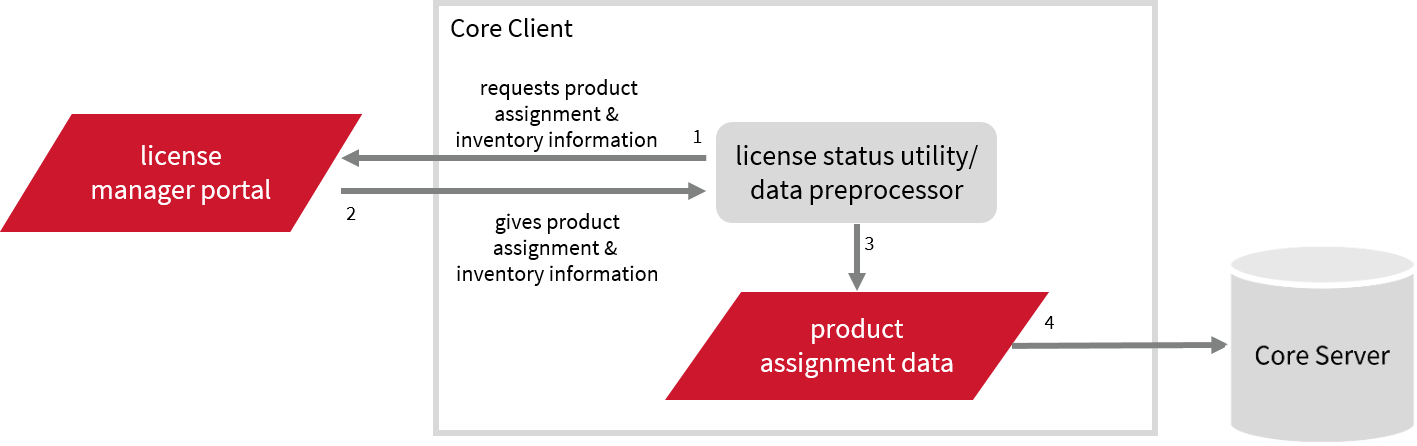
For this collection, the data source is through an API. The license status utility/data preprocessor requests the product assignment and inventory information from the license manager portal every midnight, triggering the data collection process. After the license manager portal provides the requested information, the license status utility/data preprocessor processes the data, preparing it for transmission. Finally, the product assignment data is sent to the Core Server for further storage, completing the product assignment data collection and processing.
This will produce the following aggregated data types used for historical reporting:
Apply the configurations shown in the Open iT Core Client.
Setting up SOLIDWORKS Cloud Data Collection
These are the required steps to set up data collection from the SOLIDWORKS Cloud portal.
-
Open a command prompt with Administrator level privileges.
-
Go to the bin directory, which is by default in
C:\Program Files\OpeniT\Core\bin, run the command:Command Syntaxcd <bin_dir>Examplecd C:\Program Files\OpeniT\Core\bin -
Run the command:
Command Syntaxopenit_solidworkscloud.exe --init -
Type in the username (or email) for accessing the 3DEXPERIENCE platform when prompted.
Example: Entering Username--- SolidWorks Cloud Credentials Setup ---
Enter username to use: john_doe@example.comthen press Enter.
-
Type in the password for the user account to be used for accessing the 3DEXPERIENCE platform when prompted.
Enter password: **********then press Enter.
-
Type in the platfrom ID of the 3DEXPERIENCE platform when prompted.
Enter platfrom ID: **********then press Enter.
noteOpen iT saves the hashed SOLIDWORKS Cloud credential file,
credential.jsoninC:\ProgramData\OpeniT\Data\var\Solidworks\.
Optional Parameters
| Parameter | Description |
|---|---|
--platformid <platform_id> | Use this to specify the unique identifier of the 3DEXPERIENCE platform to connect to. |
-t <temp_dir>, --tempdir <temp_dir> | Use this to specify the path to directory where the program will store temporary files. The default value is C:\ProgramData\OpeniT\Data\temp\SolidWorks.Cloud. |
-o <outdir>, --outdir <outdir> | Use this to specify the path to directory where the program will save its output. The default value is C:\ProgramData\OpeniT\Data\temp\SolidWorks.Cloud\out. |
---headless {true,false} | Use this to activate headless browser mode, where: <options> - true or false; the default mode is true. |
--datatype {subscription,user} | Use this to specify the datatype to collect and parse. |
--login-timeout <seconds> | Use this to specify the maximum time to wait for login (in seconds). The default value is 30. The minimum value is 30, and the maximum is 180. |
-b <browser>, --browser <browser> | Use this to specify which common playwright-supported browser to use (e.g., -b firefox, --browser firefox). The system will automatically install the specified browser if it is not present in the local setup; the default browser is Chromium. You can use Chromium, WebKit, or Firefox. Make sure that the browser you choose is not blocked or restricted by endpoint security policies, firewalls, or application whitelisting tools in your company's environment. Firefox browser support relies on a Windows API component that is available in newer Windows versions. On systems where the required library is not present, commands that use the --browser firefox parameter may not execute successfully. Ensure that the target environment meets the operating system requirements before using this option. |
--browserpath "<browser_path>" | Use this to specify the full path to a local browser executable (e.g., --browserpath "C:/path_to_browser/browser.exe"). Applicable to Google Chrome and Brave browsers. |
-d, --debug | Use this to turn on debug logging. |
-h, --help | Use this to display the help text. |
Activating Data Collection
These are the required steps to activate collection of SOLIDWORKS Cloud data.
-
Open a command prompt with Administrator level privileges.
-
Go to the bin directory, which is by default in
C:\Program Files\OpeniT\Core\bin, run the command:Command Syntaxcd <bin_dir>Examplecd C:\Program Files\OpeniT\Core\bin -
Once in the directory, activate the collection of SOLIDWORKS data, run the command:
Command Syntaxopenit_oconfinit -u "collect_license_solidworks-cloud.root.scheduler.jobs.collect_solidworks.general.active=true"
Advanced Configuration
The collection runs every midnight by default. To configure the intervals, locate the instances attribute under collect_solidworks or transfer_solidworks_parsed in the same file and configure the attributes.
Refer to the SOLIDWORKS Job Scheduler Instances Configuration table to learn the attributes used to configure SOLIDWORKS data collection and transfer.
| Attribute Name | Accepted Value | Description |
|---|---|---|
| max-instances | Uint (e.g., 5, 8, 9) | The number of instances allowed to run at the same time. |
| max-handling | String (end-oldest, end-all-old, or end-new) | The action done upon reaching the maximum number of instances:
|
| end-timeout | Timespan (e.g., P30S, P5M, P1H) | The maximum waiting time before terminating a running instance. |
| quarantine | Timespan (e.g., P30S, P5M, P1H) | The waiting time before starting a new instance after a previous one. |
Verifying Data Collection
After configuration, you can verify that the data is collected by following these steps:
-
Open a command prompt with Administrator level privileges.
-
Go to the bin directory, which is by default in
C:\Program Files\OpeniT\Core\bin, run the command:Command Syntaxcd <bin_dir>Examplecd C:\Program Files\OpeniT\Core\bin -
Run the command:
Command Syntaxopenit_solidworkscloud.exe -
Verify that the temp directory, which is by default in
C:\ProgramData\OpeniT\Data\tempcontains a SolidWorks.Cloud directory. Confirm that this directory includes thesession_state.jsonfile and an out subfolder containing.datafiles.
Sample Reports
Historical Reports
License Entitlements Overview
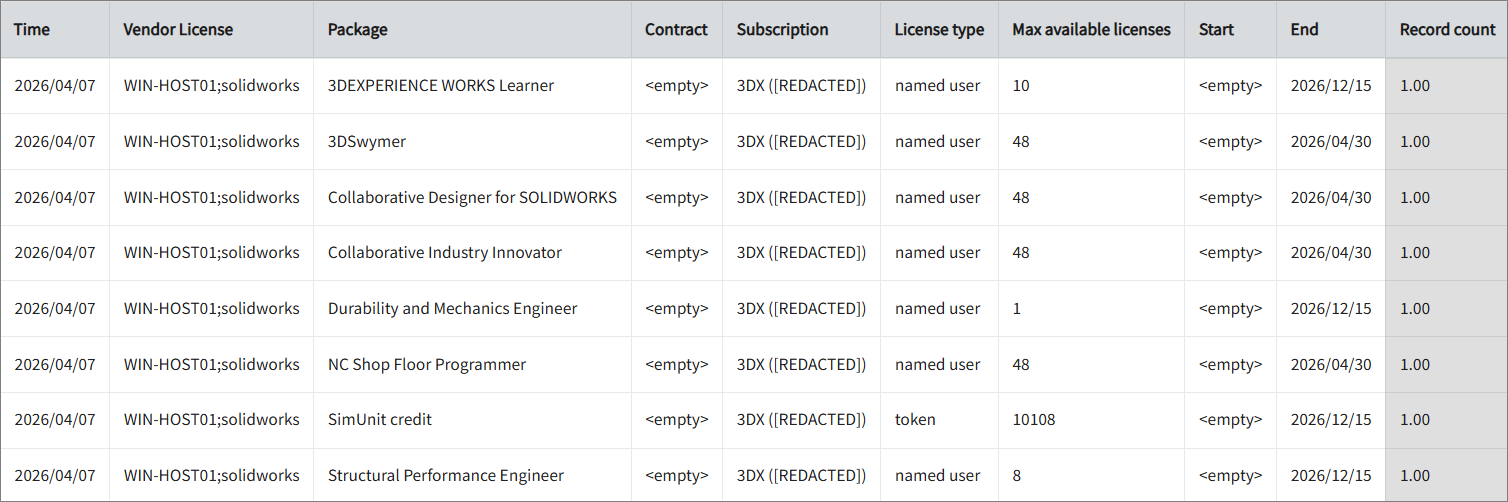
This report provides a detailed view of license entitlements per package, including license type, maximum available licenses, and subscription validity.
It offers several key benefits:
- Centralized License Visibility – Gives a clear overview of all licensed packages, making it easy to track what is available across vendors and environments.
- Accurate Entitlement Tracking – Displays maximum available licenses per package, ensuring alignment with purchased entitlements.
- Subscription Monitoring – Highlights license end dates, helping you stay ahead of expirations and renewals.
- License Type Insights – Differentiates between named user and token-based licenses, supporting better management strategies.
- Capacity Awareness – Helps identify which licenses have limited availability and may require expansion.
- Audit & Compliance Support – Provides documented proof of entitlements and subscription details for audits and vendor reviews.
- Proactive Renewal Planning – Enables early action on upcoming expirations to avoid interruptions in access.
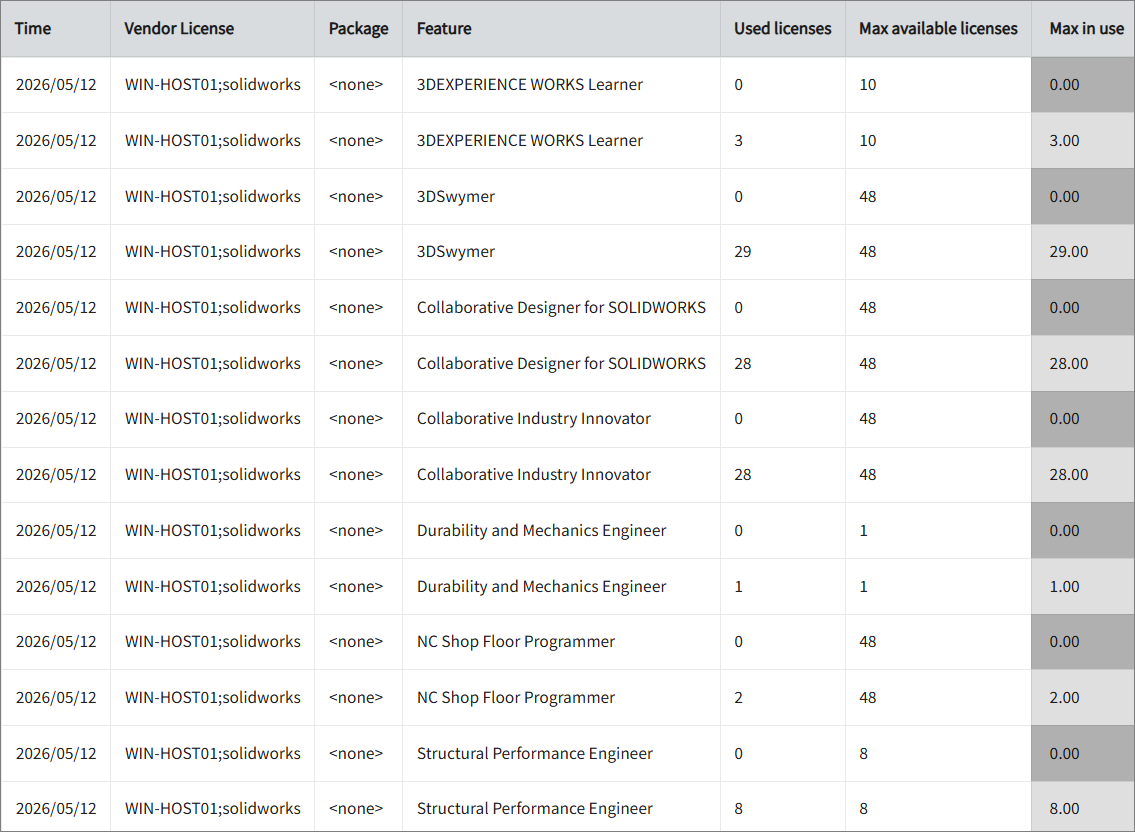
Max Available vs Max in Use
This sample report compares max in-use licenses against max available licenses.
It offers several key benefits:
- Optimized License Allocation – helps ensure you are not over-purchasing licenses you don't need or under-provisioning.
- Cost Savings – identifies opportunities to downgrade or redistribute licenses, reducing unnecessary expenses.
- Usage Trends & Capacity Planning – shows peak usage patterns, allowing better forecasting for future needs.
- Avoiding Service Disruptions – helps prevent situations where users cannot access software due to reaching the license limit.
- Compliance & Audit Readiness – provides a usage record to ensure compliance with vendor agreements and avoid penalties.
- Performance & Productivity Insights – helps assess whether certain teams or departments are under-utilizing or over-utilizing software.
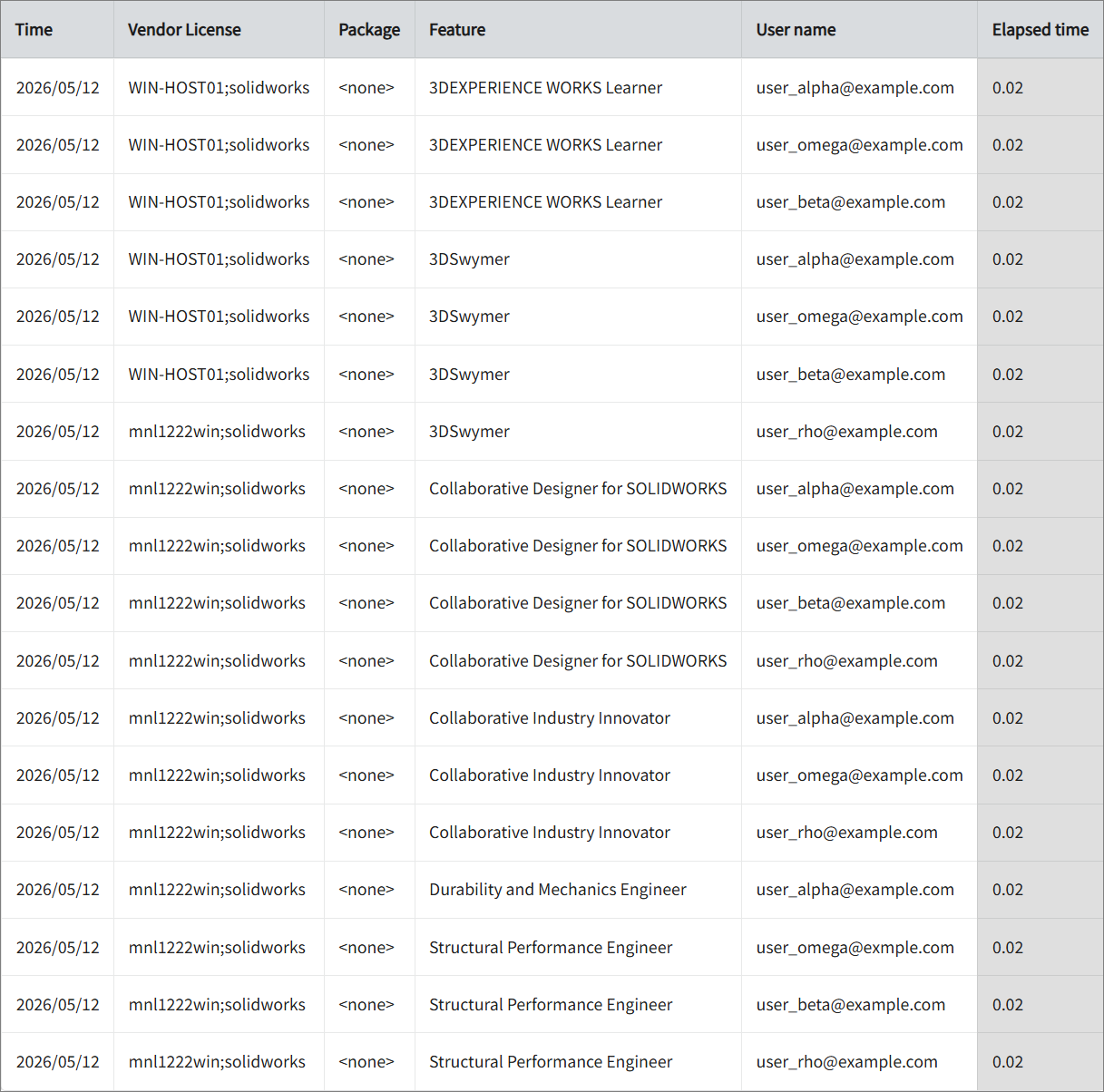
Feature Elapsed Time per User
This sample report gives you helpful insights into software use, performance trends, and user behavior.
It offers several key benefits:
- User Efficiency Analysis – tracks how much time users spend on specific features to help assess productivity.
- Identifying Workflow Issues – highlights any delays or inefficiencies in processes that could be improved.
- Usability & UX Insights – points out features that take longer to use, which could indicate design or functionality improvements.
- Training & Support Guidance – helps identify users who might need extra training to use a feature more effectively.
- Compliance Tracking – makes sure users are spending the right amount of time on regulated tasks.
- Resource & License Optimization – finds underused features or areas where too much time is spent, helping with better resource allocation.
Real-time Reports
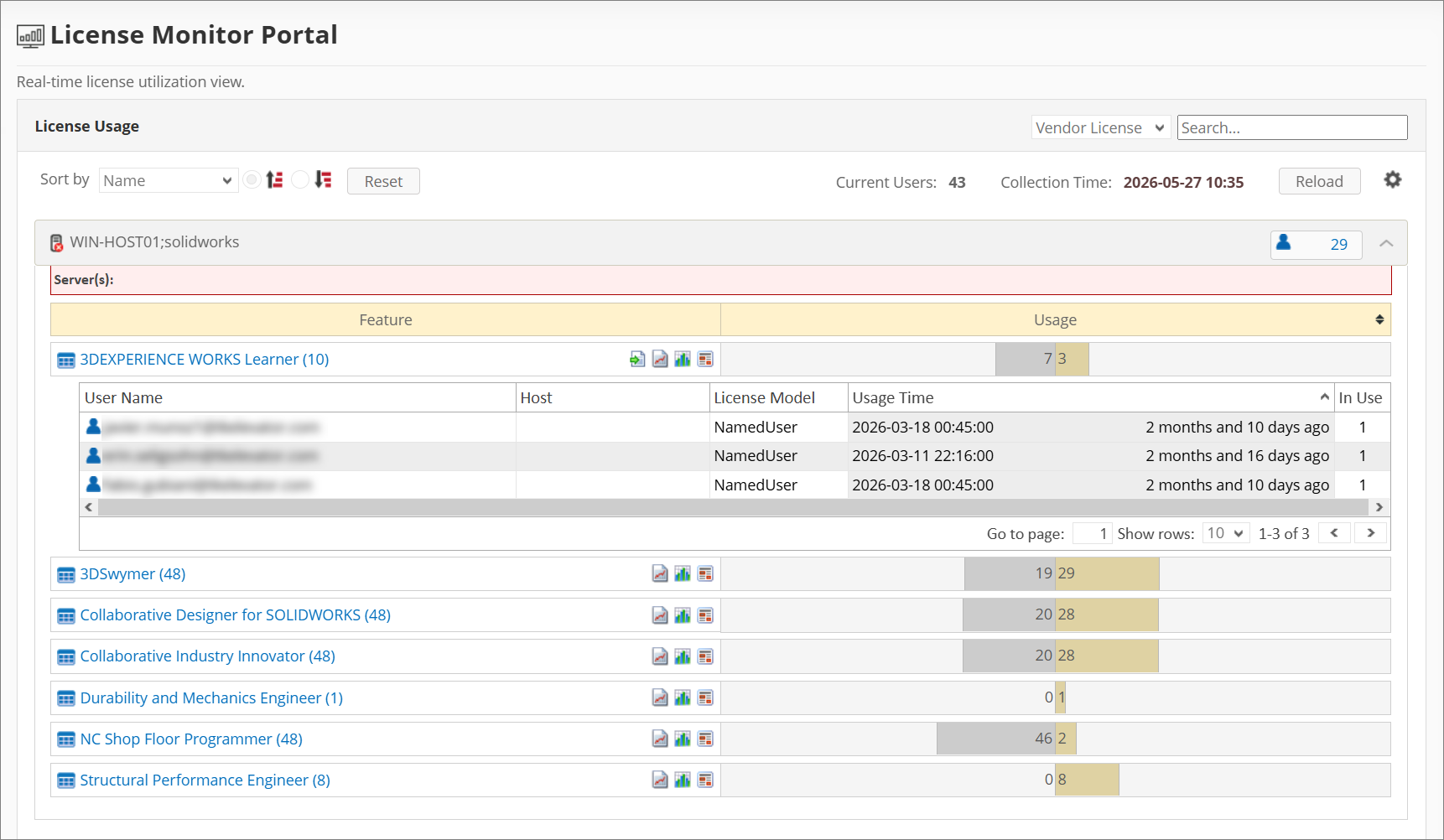
License Monitor Portal
This sample report shows a drilled-down feature view of the online licenses in use and the licenses available.
Portlet Report
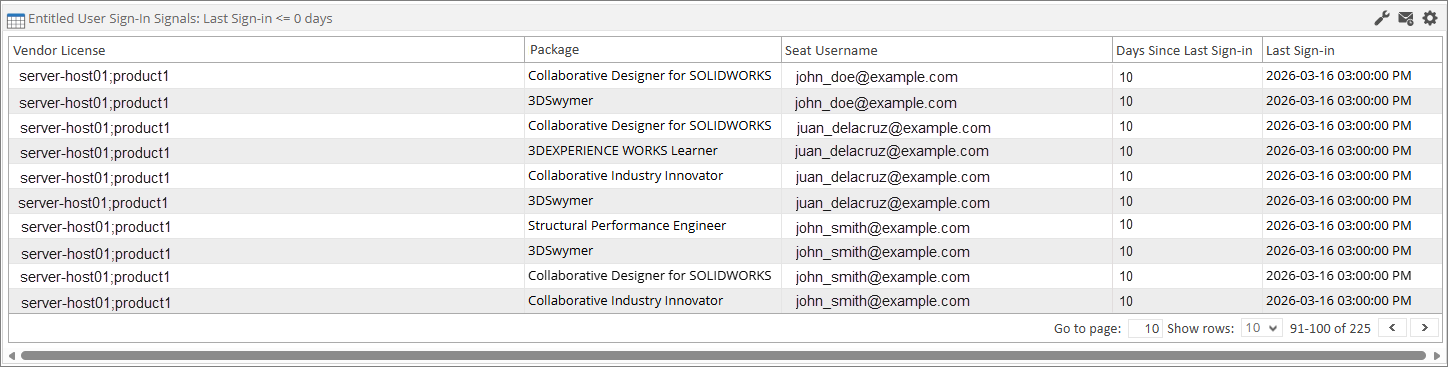
This report shows the most recent sign-in activity of entitled users per package and vendor license, based on the latest RunEtl processing.
- Recent Activity Monitoring – Tracks latest user sign-in based on processed data, providing up-to-date (but not real-time) visibility.
- Automated Alerting – Sends email notifications after RunEtl, reducing the need for manual monitoring.
- Threshold-Based Tracking – Supports configurable inactivity thresholds to flag users based on recency of access.
- Feature-Level Activity Insights – Shows which specific packages or features users last accessed.