Installation Requirements
Operating System
- Windows
- Unix
| Operating System | Version |
|---|---|
| Windows | 10 (1607 and 1809) and later |
| Windows Server | 2016 (1607) and later |
Microsoft Visual C++ Redistributable
Open iT requires Microsoft Visual C++ Redistributable for Visual Studio 2022 on Windows systems.
If a compatible version is not yet installed, download and install Visual C++ Redistributable for Visual Studio 2022 before proceeding with the Open iT installation.
.NET Framework
Open iT requires .NET Framework 4.8 or later on Windows systems.
If a compatible version is not yet installed, download and install .NET Framework 4.8 Runtime before proceeding with the Open iT installation.
| Operating System | Version |
|---|---|
| Red Hat Enterprise Linux (RHEL) | 8 and later |
| CentOS | Stream 9 and later |
Libraries
- system library libnsl.so.1 and libcrypt.so.1
- libgomp
- chkconfig (for RHEL 9.x)
- libjpeg62 or libjpeg-turbo
- libX11 and libX11-devel
- libSM
- libXext
Dedicated User and Group
- Root-level access
- Dedicated User: openit-user
- Dedicated Group: openit-group
File Descriptor Limit
Unix systems typically have a default file descriptor limit of 1024. If you are expecting a lot of distinct Core Server simultaneous users, workstation collector hosts, and license manager collector hosts, make sure that the global limit file is significantly high in the limits.conf file in /etc/security/. If you deem that the configured value is enough, you may keep it as is.
If it is not yet configured or the existing value is not enough:
-
Add the following line in the
limits.conffile:limits.conf<user> hard nofile <new_limit>limits.conf Exampleopenit hard nofile 50000This example will increase the maximum open file limit to 50,000 for the
openituser.warningThe value of the new limit must be greater than the sum of the distinct number of Core Server simultaneous users, workstation collector hosts, and license manager collector hosts.
-
Change the actual limit in the current environment, run the following command:
Command Syntaxulimit -n 50000 -
Restart the Open iT Services.
Command Syntax/opt/openit/bin/openit-all restart
Synchronized System Clocks
Verifying the time synchronization of the Open iT Core Server and Client is essential to avoid data polling with bad timestamps, which can cause data integrity loss. It is also critical for multiple clients or triad situations, especially over more than one location. NTP (Network Time Protocol) utilities, such as xntpd, are essential for achieving synchronized system clocks.
Make sure that the host is reachable by other machines over the network.
Open iT supports Red Hat OpenShift Virtualization (KubeVirt).
This enables customers to deploy and manage Windows Server and RHEL-based Open iT components on OpenShift-managed virtual machines, alongside containerized workloads, using OpenShift’s standard provisioning and management tool.
This support has been tested and verified with Open iT version 9.19.450 and 10.2.x.
Component Requirements
The following components are required or recommended for installing the Open iT Core Server.
Required Components
PostgreSQL Database
Starting with Open iT Core Server 10.3, a PostgreSQL database is required for storing operational data.
You may choose one of the following during installation:
- Use the bundled PostgreSQL included with the installer
The installer will automatically install and configure PostgreSQL. No additional setup is required. - Use an existing PostgreSQL instance
Ensure that the PostgreSQL instance meets the following requirements:- Supported version: PostgreSQL 14 or later
- The database server is accessible from the Core Server machine
- A database is already created for Open iT
- A PostgreSQL user with sufficient privileges is available
Additional Configuration for a Remote PostgreSQL Server
If the PostgreSQL instance is installed on a different machine from the Open iT Core Server, the following configuration is required to allow the Open iT Core Server to connect to PostgreSQL:
- Update the
pg_hba.conffile to allow connections from the Open iT Core Server - Use the recommended authentication method:
scram-sha-256
For detailed information about configuring pg_hba.conf and supported authentication methods, refer to the official PostgreSQL documentation: https://www.postgresql.org/docs/current/auth-pg-hba-conf.html
Recommended Components
Open iT Ingress
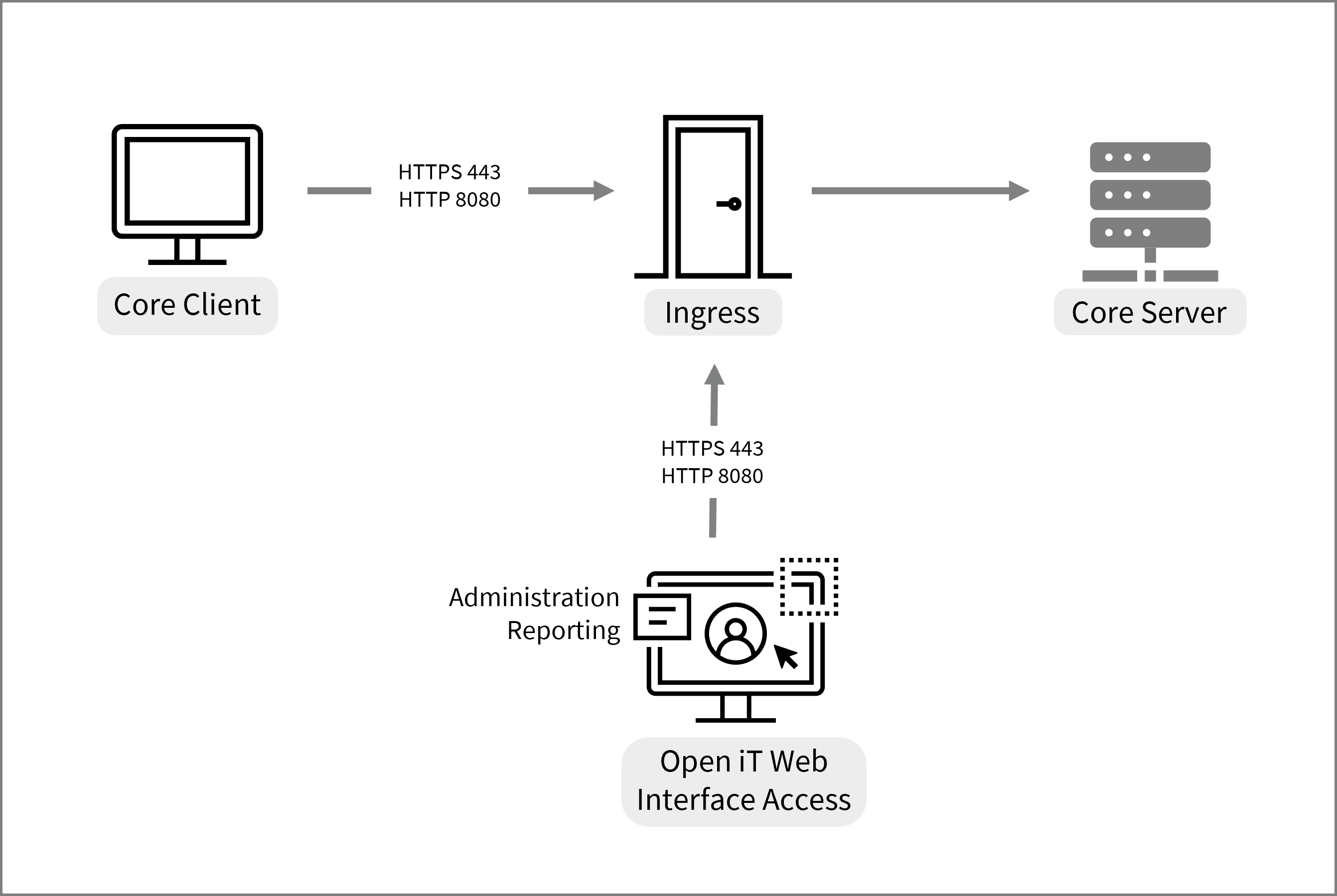
Open iT Ingress is recommended to enable access to the Open iT web interface.
You may proceed with the installation without Ingress and configure it later if needed.
Administrative Rights
The Open iT Core Server and Client installation requires Administrative Access Rights to the host machine for successful directory and file creation.
Enabling 8.3 Name Creation
8.3 name creation is a feature that automatically generates short (DOS-style) file and folder names to ensure compatibility with applications that cannot process long paths.
If you are installing the Open iT Core Server on a drive where 8.3 name creation is disabled, or in a directory whose path contains spaces in the folder name (e.g., D:\Program Files\OpeniT), you must enable 8.3 name creation before proceeding with the installation.
If you are installing on a drive where 8.3 name creation is already enabled (e.g., Drive C:), or in a directory without spaces in the folder name (e.g., D:\OpeniT), you may skip this step and proceed with the installation.
Some drives, such as Drive D:, typically have 8.3 name creation disabled by default. This can cause Open iT components to fail when accessing paths that contain spaces. Follow this guide to check and enable 8.3 name creation to ensure the proper installation and operation of the Open iT Core Server.
-
Open a command prompt with Administrator privileges.
-
Check the 8.3 name creation setting for your installation drive. In this scenario,
Drive D:will be the installation drive. Run the command:Command Syntaxfsutil 8dot3name query D:Example output when 8.3 name creation is disabledThe volume state is: 1 (8dot3 name creation is DISABLED)
The registry state is: 2 (Per volume setting - the default) -
Enable the 8.3 name creation for
Drive D:, run the command:Command Syntaxfsutil 8dot3name set D: 0noteThis change is not retroactive. Only newly created folders or files on
Drive D:will be affected. Existing items will not automatically receive short names. -
Verify that 8.3 name creation has been enabled on your installation directory, run the command:
Command Syntaxfor %A in ("<install_dir>") do @echo %~sAwhere
<install_dir>is the path of the installation directory.Examplefor %A in ("D:\Program Files\OpeniT") do @echo %~sAExample result when 8.3 name creation is enabledD:\PROGRA~1\OpeniT -
Proceed with the Core Server installation.
Open iT Software
Download the Open iT Core Server installer from the Customer Portal.
Step 1: Access the Customer Portal
-
Go to the Open iT Customer Portal.
-
When prompted, provide a valid email address.
-
Click NEXT.
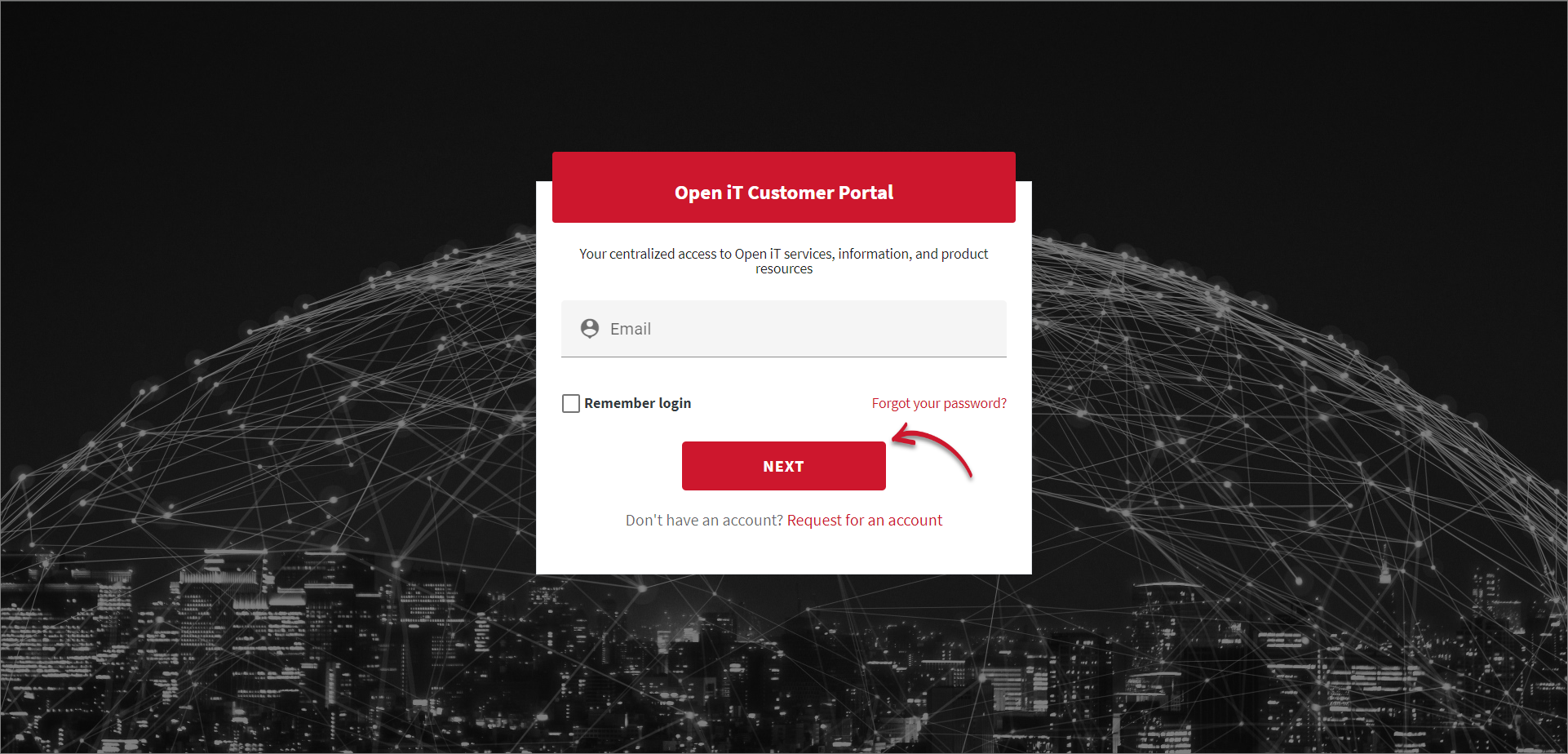 Customer Portal Login
Step 2: Request an Account (if needed)
If you do not have an account:
-
Click Request for an account at the bottom of the dialog.
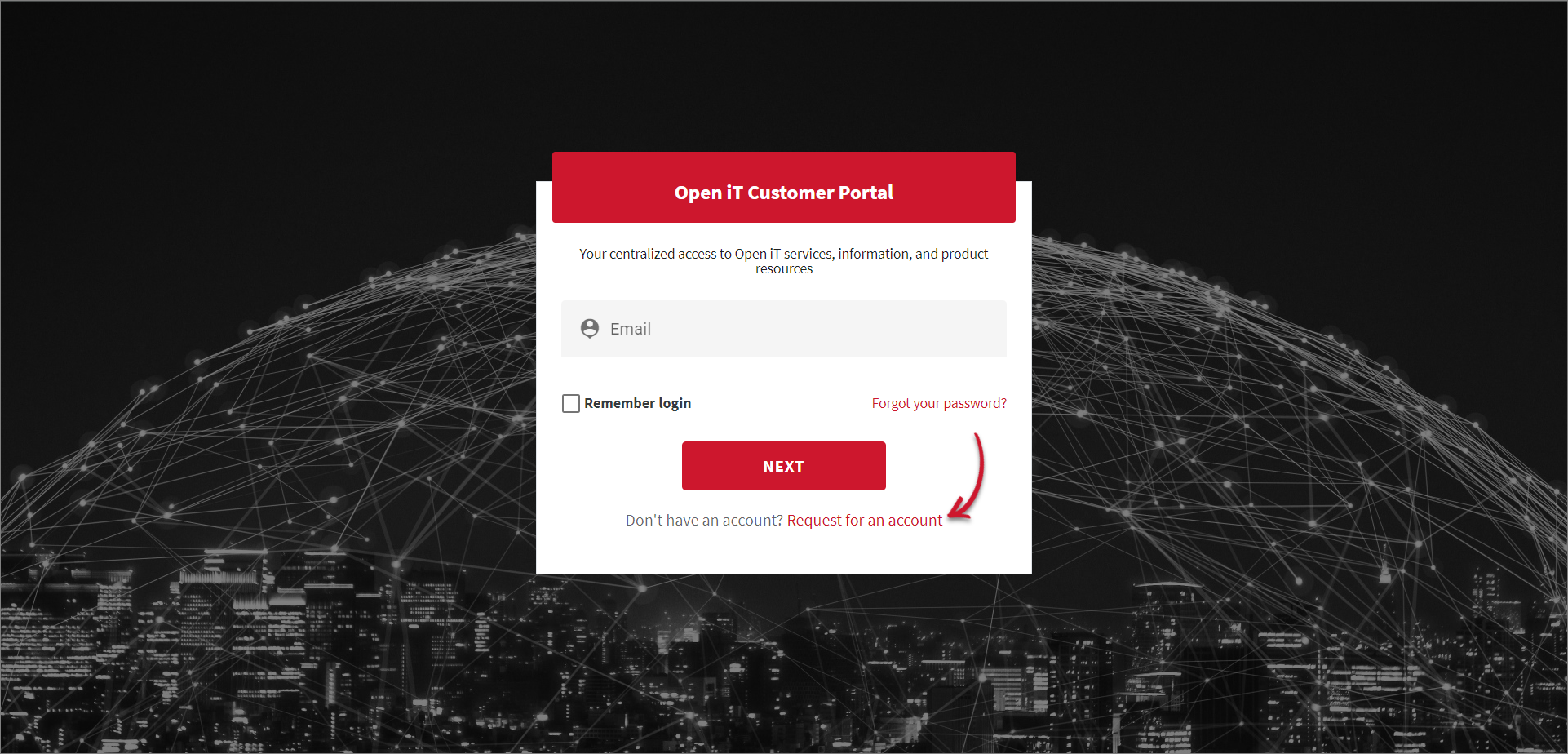 Customer Portal Account Request
The link redirects to the Request Account dialog.
-
Provide the required details.
-
Click REQUEST.
-
Wait for our Sales Representatives to validate the request. Once validated, an email will be sent to the provided email address.
 Request Account
Step 3: Download the Installer
-
Log in to the Customer Portal.
-
Click Releases.
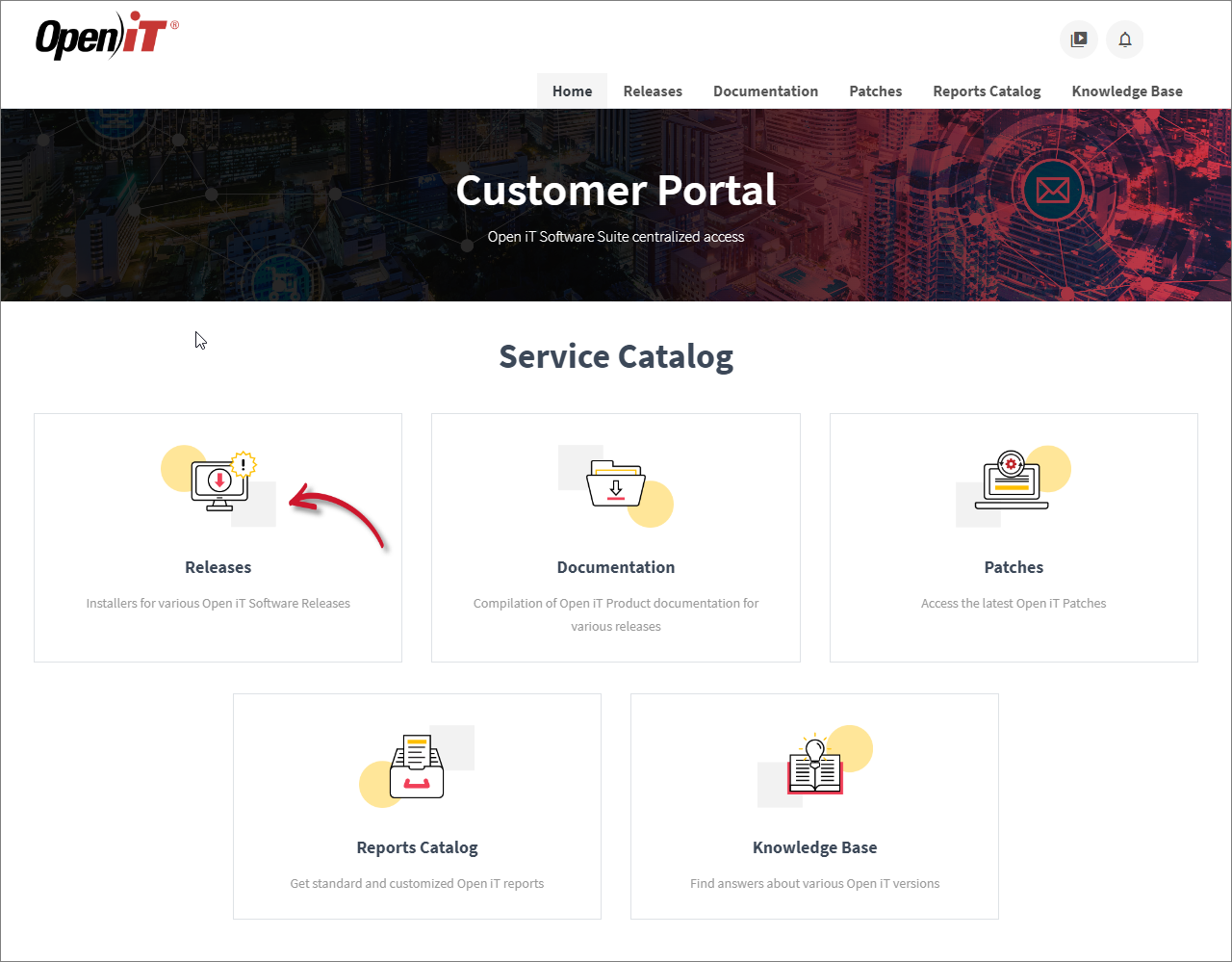 Releases
 -
Click the Download button of the specific product, then select the appropriate installer file to download.
warningIt is recommended to install the current stable version for production purposes.
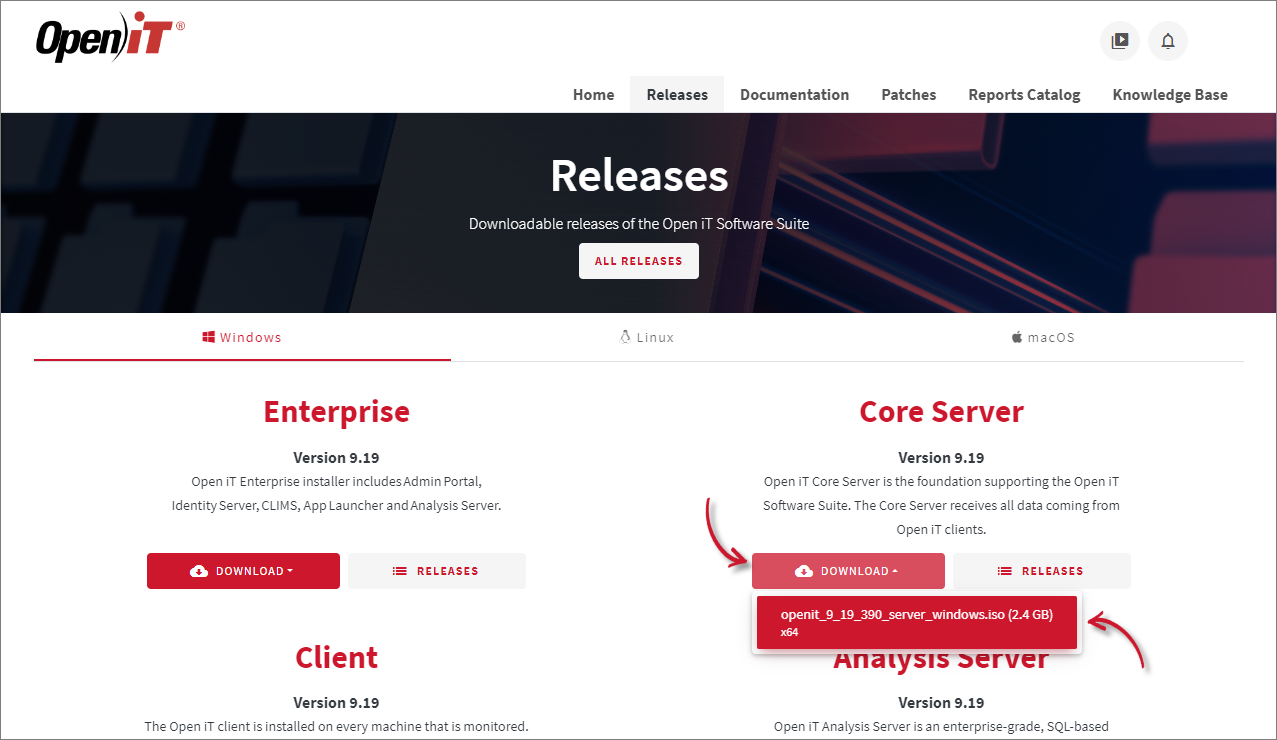 Download Installer
Step 4: Download a Specific Version (Optional)
If you need a previous or specific version:
-
Click Releases for the selected product.
-
Browse the list of available versions.
-
Click the version number to access the download page.
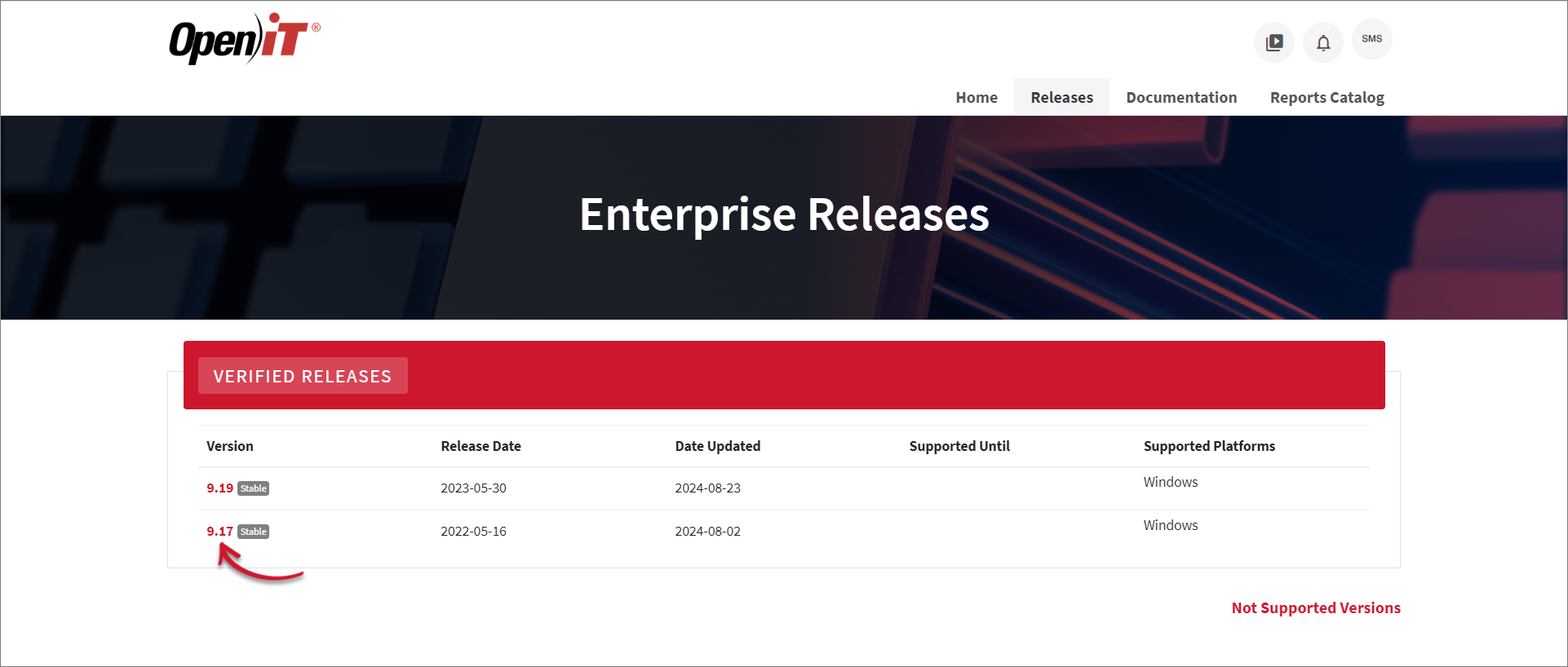 Previous Version
Open iT Software License
The setup program installs the Open iT software with a temporary license to run it immediately. Install a proper license key as soon as possible.
Send an email request to license@openit.com to obtain a proper license key.
Port Numbers Used by Open iT
The unified navigation for Open iT web interface uses port 443 for HTTPS and port 8080 for HTTP as the primary entry points.