Generating Power BI Data Source
Open iT can extract the Core Server database into CSV files to be able to load it in Power BI.
Activating Power BI Data Source Generation
These are the required steps to activate Power BI data source generation.
- Windows
- Unix
-
Open a command prompt with Administrator level privileges.
-
Go to the bin directory, which is by default in
C:\Program Files\OpeniT\Core\bin, run the command:Command Syntaxcd <bin_dir>Examplecd C:\Program Files\OpeniT\Core\bin -
Once in the directory, activate the data source generation to run daily, run the command:
Command Syntaxopenit_yamlinit coreserver update asset process_powerbi:general.active=true -
Open the Task Manager.
5 Under the Services, restart the OpeniTCoreServerPipeline service.
-
Go to the bin directory, which is by default in
/opt/openit/bin, run the command:Command Syntaxcd <bin_dir>Examplecd /opt/openit/bin -
Once in the directory, activate the data source generation to run daily, run the command:
Command Syntax./openit_yamlinit coreserver update asset process_powerbi:general.active=true -
Restart the Open iT Core Server Pipeline service, run the command:
Command Syntaxsystemctl restart openit-coreserverpipeline
Verifying Power BI Data Source Generation
After configuration, you can verify that the Power BI data source is generated by following these steps:
-
Verify that there is a folder named powerbi present in your defined
<data_dir>(commonly located in Windows:C:\ProgramData\OpeniT\Data\databaseor Unix:/opt/openit_data/database)upon Open iT server installation, containing the folders of the configured data types. -
Access the Data Processing GUI by navigating:
-
With Ingress:
https://<ingress-uri>/dagster-webserveror use the link in the navigation menu.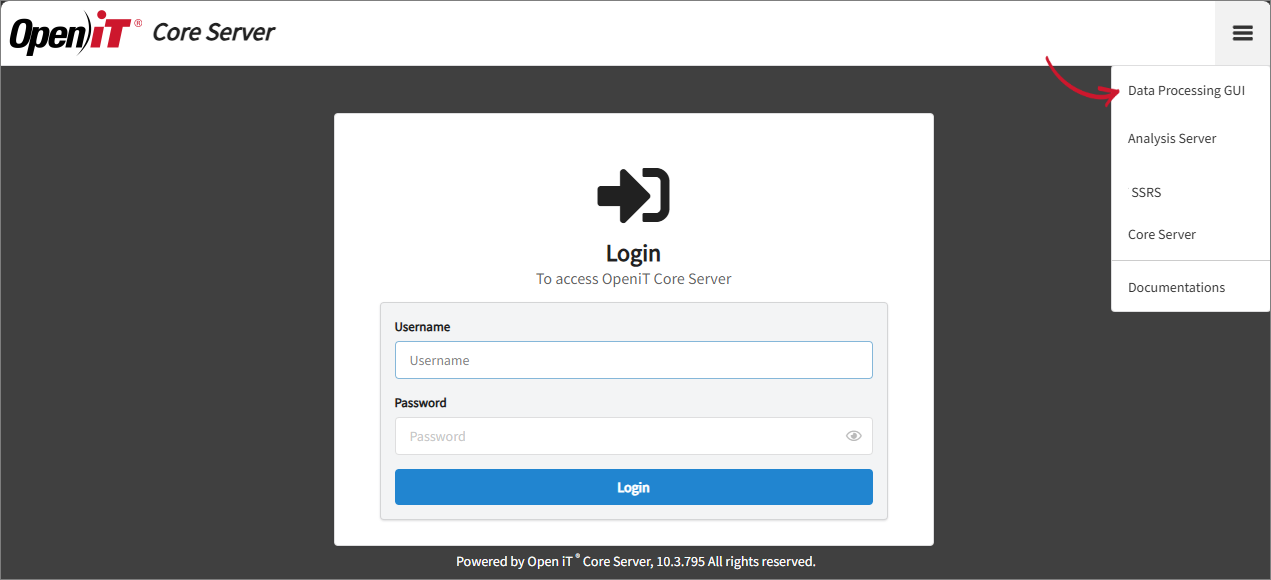 Data Processing GUI Link
 -
Without Ingress:
http://localhost:27910/dagster-webserver
-
-
In the left navigation pane, click Lineage.
-
Expand the downstream item from the list of groups.
-
Right-click process_powerbi, select Materialize.
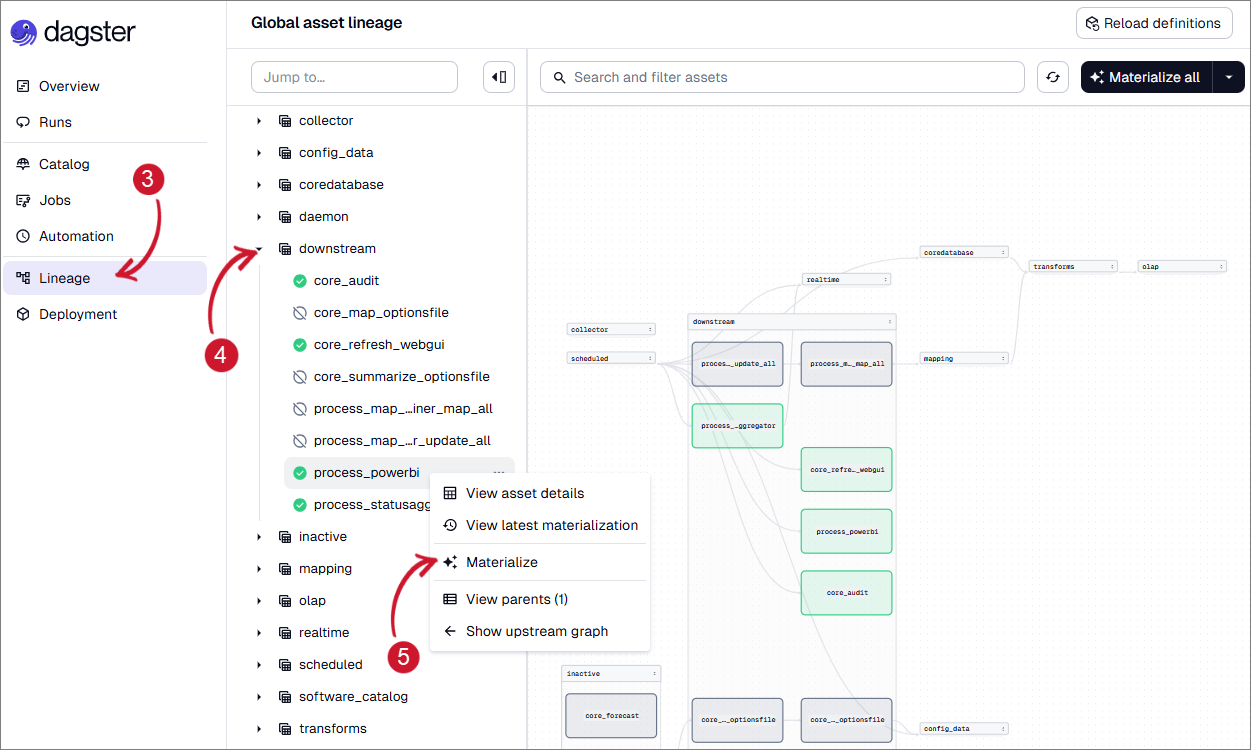 Data Processing GUI PowerBI
 -
Verify the output inside the data type directories (e.g.,
<data_dir>\powerbi\94) with the formatyear-month-date.csv. There should also be a cache file per data type.The output files are fixed to a daily resolution, and the delimiter is always colon.
The implementation of caching guarantees that no date per data type will be processed more than once. However, this does not guarantee data stability if the server machine shuts down while the tool is running.
To ensure data reliability in such cases, delete the cache file and output file in each data type on the date the server machine shuts down, then restart the server, making sure that the scheduler is active.
The caching implementation not only checks for the cache file, but also for the existence of output files starting from the date as calculated by the value of the POWERBI_CUTOFF_AGE directive.